
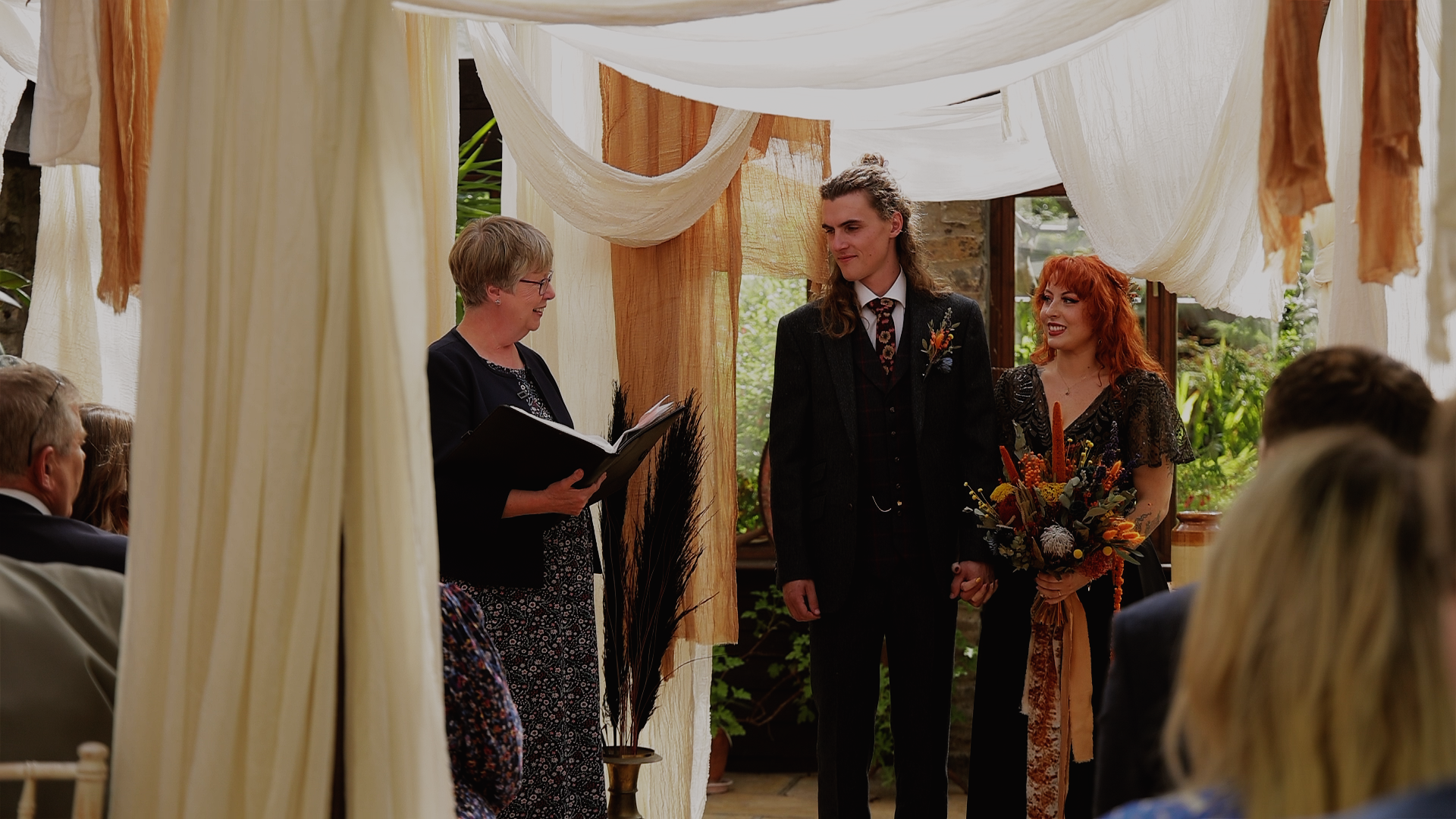
When couples start planning their wedding ceremony, one of the decisions they often come across is whether to have a registrar-led ceremony or a celebrant-led ceremony.
While both play an important role in your wedding day, they serve very different purposes in the UK, and that difference can have a real impact on how your final wedding film feels.
As a cinematic wedding videographer based in Plymouth and working across Devon, Cornwall, and the wider UK, I see first hand how both the structure and the setting of a ceremony can shape the story we are able to tell through film.
What a Registrar Ceremony Offers
Registrar ceremonies are the legal part of getting married in the UK.
They are structured, efficient, and follow a set format to ensure everything is legally binding. In recent years, many registrars have made real efforts to include more personal touches within that structure, which is a really positive step for couples.
It is now quite common to see elements such as:
- Short stories about the couple
- Ring exchanges with slightly more personalised wording
- Unity ceremonies such as sand blending or tying a knot
- More relaxed personal vows in some cases
These additions definitely help bring more warmth and personality into what was once a very formal process.
However, there are still restrictions.
Because registrar ceremonies must remain legally compliant, there are clear limitations on content. One of the most significant is that there cannot be any religious wording, references, or religious imagery included within the ceremony.
This means no religious readings, no hymns, and no faith-based language can be incorporated, even if it is personally meaningful to the couple or their families.
This naturally shapes the tone of the ceremony and often means it takes place within licensed venues, which can also influence the overall feel and visual style of your wedding film.
What a Celebrant Ceremony Actually Means in the UK
This is where there is often some confusion.
In the UK, a celebrant cannot legally marry you.
Instead, couples usually complete the legal part of the marriage separately, typically in an intimate ceremony at a registry office on another day. The celebrant ceremony is then held as a completely separate, personalised celebration of your marriage.
And this is where things really open up.
A celebrant-led ceremony gives you complete freedom over structure, content, and tone. It often includes:
- Detailed stories about your relationship
- Family contributions and shared memories
- Readings that feel personal to you
- Fully bespoke vows
- Symbolic rituals that reflect your journey together
Because there is no fixed framework shaping the ceremony, couples are free to include whatever feels meaningful to them, whether that is cultural traditions, personal beliefs, or shared experiences that define their story.
Another key difference is location. Celebrant ceremonies are not restricted to licensed venues, which means they can take place in far more personal or unique settings, whether that is a countryside field, a private garden, or coastal locations like Cornish cliffs or beaches in places such as Weymouth.
These environments naturally become part of the storytelling. The space, the light, and the atmosphere all feed into how the day feels on film.
From a filmmaking perspective, it means I am not just capturing a ceremony, but capturing a moment that is deeply connected to both the people and the place.
Why This Matters for Your Wedding Film
The ceremony is one of the most important parts of your wedding film.
It is where your story is spoken out loud in front of your closest people. It is where emotion, meaning, and context naturally come together in real time.
The more personal detail there is within the ceremony, the more naturally your film comes to life in the edit.
That might include:
- How you met and how your relationship developed
- Personal stories shared by your celebrant or registrar
- Readings that reflect your journey as a couple
- Emotional reactions from family and friends
- Vows written in your own words
All of these elements help build a stronger narrative, not just for the highlight film, but for your full feature film as well.
In simple terms, the more of your story that is spoken on the day, the more naturally it can be woven into a cinematic wedding film that feels complete and emotionally connected.
Registrar vs Celebrant: It Is Not About Better or Worse
It is important to say that one option is not better than the other.
I have filmed beautiful weddings with both registrar and celebrant-led ceremonies, and both can produce incredibly emotional and meaningful films.
The key difference is usually how much personal storytelling is built into the ceremony itself, and how that contributes to the overall narrative of your wedding film.
A registrar ceremony often gives you a clear, structured foundation with some personal touches, usually within a licensed venue setting.
A celebrant ceremony gives you full freedom to tell your story in more depth, often in a location that feels more personal or meaningful to you as a couple.
Both are valid. It simply depends on the kind of experience you want on the day, and how you want that story to be remembered afterwards.
Final Thoughts
Your wedding film is built from real words, real emotion, and real moments.
Whether you choose a registrar ceremony, a celebrant-led ceremony, or a combination of both, your story will still be captured in a cinematic and thoughtful way.
But if storytelling is important to you, it is worth considering how much of your journey you want included within the ceremony itself, and where that story will take place. Because both the words and the setting often become the emotional foundation of your wedding film.
The more personal your ceremony feels, the more naturally your story unfolds on screen, and the more powerful the final film becomes when you watch it back in the years ahead.
If you are planning a wedding in Devon, Cornwall, or anywhere in the UK and want a cinematic wedding film that focuses on real storytelling and emotion, I would love to chat.